The small satellite revolution has transformed modern space exploration, making low-Earth orbit (LEO) accessible to universities, research laboratories, startups, and defense agencies worldwide. At the core of every successful nanosatellite mission is a rugged, highly dependable framework designed to endure the extreme mechanical stresses of launch and the harsh thermal conditions of space.
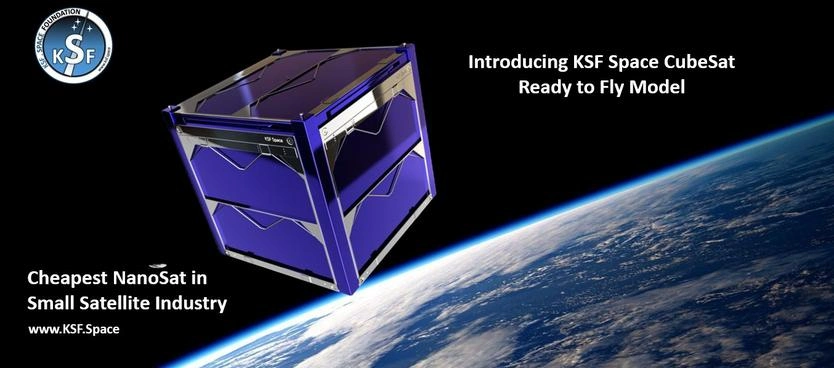
When engineers evaluate the mechanical foundation of their spacecraft, their primary focus centers on finding an optimized Cubesat strcuture frame chasses configuration. KSF Space has established itself as an industry leader in this sector, engineering ultra-affordable, modular, and flight-proven CubeSat structure configurations. Spanning a versatile product line from standard 1U kits up to massive 24U architectures, KSF Space provides high-precision manufacturing options that smoothly bridge the gap between complex orbital requirements and practical budget limits.
Why the CubeSat Structure Frame Chassis Dictates Mission Success
A small satellite’s structural framework is far more than a basic metal enclosure. It serves as the primary load-bearing skeleton that protects highly sensitive payloads, onboard computers, electrical power systems (EPS), and attitude control modules from catastrophic structural failure.
Surviving the Launch Environment
During launch, a rocket subjects its internal payloads to extreme acoustic noise, random vibrations, and sustained mechanical acceleration forces. If a Cubesat strcuture frame chasses possesses insufficient structural damping or lacks rigidity, it can experience resonant frequencies that permanently damage internal printed circuit boards (PCBs) or cause structural cracking. KSF Space addresses this challenge by engineering chassis components validated against the stringent NASA-GSFC-STD-7000 (GEVS) guidelines. This mathematical and physical validation guarantees that every assembly possesses an optimal factor of safety to clear launcher integration requirements easily.
Overcoming Thermal Transients in a Vacuum
In the near-vacuum of space, traditional thermal convection does not exist. A spacecraft relies completely on thermal radiation and conductive paths to dissipate heat generated by internal electronics or absorbed from solar radiation. High-grade CubeSat structure systems incorporate optimized conductive paths and specialized surface treatments, ensuring internal temperatures stay comfortably within strict operational qualification limits.
This advanced engineering approach was highlighted in a technical publication featured in Satnews, which detailed the critical role of thermal equilibrium and isotherms in preventing subsystem overheating and maximizing operational lifespans in orbit.
The KSF Space Multi-Size Lineup: From 1U to 24U Solutions
Different missions call for completely different volumetric capacities and payload requirements. KSF Space addresses this broad spectrum by manufacturing standardized, modular chassis designs across seven distinct form factors:
1U, 2U, and 3U Kits: The foundational blocks of the nanosatellite sector. These configurations are ideal for academic research, localized sensor testing, rapid technology demonstrations, and initial orbital training missions.
6U and 12U Frameworks: Engineered to accommodate advanced Earth observation imagers, complex laser communication terminals, and multi-band radio frequency payloads.
16U and 24U Heavy-Duty Chassis: These large-scale configurations support deeply integrated multi-payload setups, complex propulsion modules for deep-space profiling, and massive deployable solar arrays.
Every modular CubeSat structure is fully compliant with standard containerized dispensers, which drastically simplifies the deployment phase and ensures flawless separation once orbit is reached.
Advanced Materials Science: Laser-Melted Aluminum vs. High-Ductility PA11
To provide the ideal balance of mechanical stiffness, weight management, and affordability, KSF Space leverages cutting-edge additive manufacturing methodologies. As officially covered in a Satnews launch report detailing KSF Space’s commercialization of additive-manufactured small satellite frameworks, engineering teams can pick between two advanced materials depending on their exact mission profile.
1. Aerospace-Grade Laser-Melted Aluminum (AlSi10Mg)
Available for the entire lineup from 1U up to 24U, these frames are designed for long-duration orbital missions requiring absolute rigidity and supreme thermal dissipation.
The Technical Edge: This powder-bed fusion process permits organic geometries and built-in internal routing paths for electrical wire harnesses, cutting down overall structural mass while avoiding the raw material waste of subtractive manufacturing.
Shot-Peened Mechanical Finish: After fabrication, the aluminum frames undergo a specialized shot-peening process. By bombarding the surface with precision spherical media, a layer of compressive residual stress is created. This structural enhancement blocks micro-cracks from developing during intense acoustic and high-G launch environments.
2. High-Performance Multi Jet Fusion (MJF) PA11
For rapid suborbital tests, atmospheric balloon platforms, or hyper-tight budgetary frameworks, KSF Space offers an innovative lightweight polymer series. Please note that PA11 production is strictly dedicated to 1U, 2U, and 3U small satellite forms.
Isotropic Material Integrity: Unlike common commercial 3D printers that create brittle, layered filament structures with weak points, the Multi Jet Fusion powder-bed process yields 99.9% dense, isotropic structures. This completely eliminates the threat of layer delamination during mechanical stress.
Surface Treatments: Available in a raw industrial gray or a chemically smoothed, vapor-honed Black Smooth finish. The advanced black smooth treatment drastically lowers the surface area to eliminate microscopic debris while simultaneously refining outgassing characteristics in high-vacuum environments.
Breaking Down the Market: Unmatched Cost Advantage
A major obstacle for emerging space programs and academic teams has long been the high price tag of flight-ready satellite structures. KSF Space has systematically removed this barrier by offering some of the most competitive pricing structures across the global aerospace industry.
Isotropic Material Integrity: Unlike common commercial 3D printers that create brittle, layered filament structures with weak points, the Multi Jet Fusion powder-bed process yields 99.9% dense, isotropic structures. This completely eliminates the threat of layer delamination during mechanical stress.
Surface Treatments: Available in a raw industrial gray or a chemically smoothed, vapor-honed Black Smooth finish. The advanced black smooth treatment drastically lowers the surface area to eliminate microscopic debris while simultaneously refining outgassing characteristics in high-vacuum environments.
The tables below showcase the financial advantages of selecting KSF Space compared to traditional market averages:
Flight-Ready Laser-Melted Aluminum Structures (1U - 24U)
| Form Factor | Industry Market Average | KSF Space Standard Pricing | Total Cost Savings |
|---|---|---|---|
| 1U Metal Chassis | $1,500+ | $1,000 | 20% Savings |
| 2U Metal Chassis | $2,700+ | $2,000 | 21% Savings |
| 3U Metal Chassis | $4,200+ | $2,500 | 31% Savings |
| 6U CubeSat Structure | $8,500 | $5,000 | 41.18% Savings |
| 12U CubeSat Structure | $15,000 | $10,000 | 33.33% Savings |
| 18U CubeSat Structure | $21,000 | $14,000 | 33.33% Savings |
| 24U CubeSat Structure | $38,000+ | $22,000 | 42.11% Savings |
Lightweight Innovation: PA11 CubeSat Structure 1U, 2U, 3U
| Form Factor | Industry Market Average | KSF Space Standard Pricing | Total Cost Savings |
|---|---|---|---|
| 1U PA11 Chassis | $700+ | $500 | 24% Savings |
| 2U PA11 Chassis | $1,000+ | $700 | 29% Savings |
| 3U PA11 Chassis | $1,500+ | $1,000 | 31% Savings |
Tailored For Your Mission: Customization and Flight Heritage
Space missions are rarely one-size-fits-all. KSF Space prides itself on its ability to offer fully customizable structure modifications tailored to meet the specific requirements of any mission. Whether your payload requires dedicated optical cutouts, specific mounting brackets for micro-thrusters, custom internal partitioning, or non-standard deployment rails, KSF Space’s engineering team can adapt the frame to match your exact SOLIDWORKS or STEP configurations.

Real Flight Heritage You Can Depend On
Investing in space hardware requires high confidence to avoid “infant mortality” (subsystem failure shortly after launch). Every customized CubeSat structure carries extensive flight heritage, backed by successful deployments ranging from high-altitude stratospheric exploration to orbital missions conducted alongside global academic and space institutions. When you integrate your subsystems into a KSF Space frame, you are selecting architecture that has successfully navigated the vacuum of space.
1U Structure Laser Melted Aluminum (a high-strength, flight ready component) Highest Performance

2U Structure Laser Melted Aluminum (a high-strength, flight ready component) Highest Performance

3U Structure Laser Melted Aluminum (a high-strength, flight ready component) Highest Performance

6u cubesat structure ksf space

12u cubesat structure ksf space

16u cubesat structure

24u cubesat structure ksf space

cubesat structure sizes KSF Space

Frequently Asked Questions (FAQ)
What material options does KSF Space offer for its CubeSat chassis frames?
KSF Space manufactures structures using aerospace-grade Laser-Melted Aluminum (AlSi10Mg) finished with professional shot peening for orbital durability (available across all sizes from 1U to 24U), as well as bio-sourced Polyamide PA11 via Multi Jet Fusion (MJF) for highly ductile, ultra-lightweight applications.
Are the lightweight PA11 structures available for large sizes like 6U or 12U?
No. The high-performance MJF PA11 polymer option is strictly limited to smaller form factor variants, specifically the 1U, 2U, and 3U sizes. Larger configurations from 6U up to 24U are built exclusively utilizing aerospace-grade Laser-Melted Aluminum to ensure optimal rigid load management.
Can KSF Space customize a Cubesat strcuture frame chasses for a custom payload?
Yes. KSF Space specializes in providing customizable structural modifications based on a client’s specific mission payload, antenna deployment mechanisms, or optical alignment constraints. Teams can submit their specific layout requirements during the design phase.
Where can I read more about KSF Space's industry validation?
KSF Space’s breakthroughs have been heavily documented across major aerospace publications, including an official commercial release report in Satnews detailing the launch of their additive-manufactured PA11 architectures, alongside an in-depth Satnews technical article detailing their expertise in achieving spacecraft thermal equilibrium.
Are these structures compliant with standard launch deployers?
Absolutely. Every 1U through 24U CubeSat structure frame built by KSF Space strictly follows standardized design specifications, making them fully compatible with leading containerized deployment mechanisms and dispensers worldwide.
As featured on Satnews

KSF Space Commercializes Additive-Manufactured CubeSat Structures
KSF Space announced on Friday, January 9, 2026, the commercial availability of an expanded lineup of CubeSat structures, positioning the series as the most affordable
Read More
Thermal equilibrium highlights KSF Space's expertise
In satellite-based Earth observation, isotherms are primarily used to analyze the thermal structure of the atmosphere. Infrared sounders and imagers,
Read More