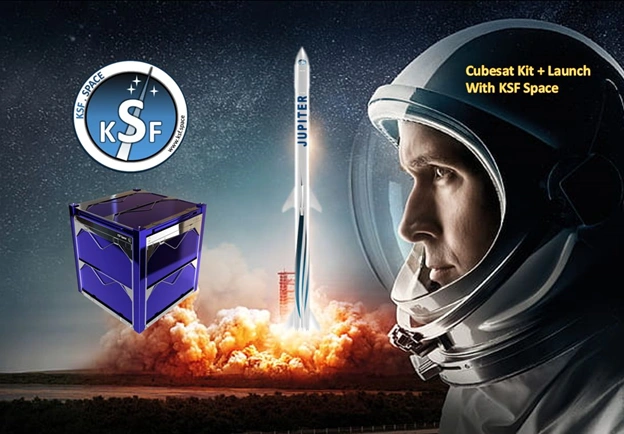
The KSF Space Foundation, a USA-registered non-profit organization, is transforming the global space industry by introducing what is widely recognized as the world’s cheapest CubeSat solution. Designed specifically for universities, research institutions, schools, startups, and space innovators, the KSF Space CubeSat Kit removes one of the biggest barriers to entering the space sector: cost.
For decades, developing a satellite required substantial funding, making space missions accessible only to governments and large aerospace companies. Today, KSF Space is changing that reality by providing an affordable, high-quality CubeSat platform that enables educational institutions and researchers worldwide to build, test, and prepare real satellite missions without requiring multi-million-dollar budgets.
What Makes the KSF Space CubeSat Different?
The KSF Space CubeSat Kit Version 2.0 has been engineered to provide a complete educational and research platform. Instead of purchasing separate satellite subsystems from multiple vendors, users receive an integrated solution that simplifies CubeSat development while significantly reducing costs.
Key advantages include:
- The world’s cheapest CubeSat platform for education and research.
- Complete satellite hardware ready for integration.
- Modular architecture for easy customization.
- Low power consumption and lightweight design.
- Ready for laboratory testing and near-space missions.
- Suitable for universities, STEM programs, research centers, and aerospace startups.
- Designed for real-world satellite engineering education.
Democratizing Access to Space Technology
One of the primary goals of the KSF Space Foundation is to democratize space technology.
Many universities around the world dream of developing their own satellite missions but struggle with limited budgets. Traditional CubeSat development often requires significant investment in engineering, manufacturing, testing, and integration.
KSF Space eliminates many of these financial barriers by providing affordable CubeSat hardware, technical support, and educational resources that allow institutions to launch satellite development programs using existing academic budgets rather than seeking large external grants.
Ideal for Universities and Research Institutions
The KSF Space CubeSat Kit has become an excellent solution for:
- Aerospace engineering departments
- Electrical engineering programs
- Computer science faculties
- Space research laboratories
- Government research organizations
- STEM education initiatives
- Student satellite competitions
- CubeSat training programs
Students gain practical experience working with genuine satellite subsystems instead of purely theoretical concepts, preparing them for careers in the rapidly expanding NewSpace industry.
Built for Education, Innovation, and Future Space Missions
The CubeSat platform supports numerous educational and scientific applications, including:
- Earth observation experiments
- Environmental monitoring
- Climate research
- Internet of Things (IoT) demonstrations
- Space communications
- Satellite telemetry
- GPS positioning
- Scientific payload development
- Atmospheric experiments
- Technology demonstrations
Its modular architecture also enables institutions to integrate additional payloads depending on mission objectives.
Near-Space Testing Before Launch
Before deploying satellites into orbit, testing is essential.
KSF Space provides opportunities for near-space missions using high-altitude platforms reaching approximately 40 km altitude. These missions allow researchers and students to validate satellite systems, collect environmental data, and improve mission readiness before orbital deployment.
Supporting the Global NewSpace Economy
The commercial space industry continues to experience rapid growth, creating demand for skilled engineers, satellite developers, and mission specialists.
By lowering hardware costs, KSF Space enables more countries, universities, and startups to participate in satellite development, accelerating innovation while expanding global access to space technology. This approach helps cultivate the next generation of aerospace professionals capable of designing future CubeSat, NanoSat, and small satellite missions.
More Than a CubeSat Kit
Purchasing the KSF Space CubeSat Kit also opens the door to additional educational opportunities.
Eligible customers may receive enrollment opportunities in the Nanosatellite Engineering Professional (NEP) certification program, providing structured training in CubeSat engineering, satellite systems, mission planning, and aerospace technologies.
Why KSF Space Is Leading Affordable CubeSat Development
KSF Space Foundation combines affordability with engineering quality, making satellite development accessible to organizations of all sizes.
Whether the objective is launching a student satellite, conducting climate research, testing new payload technologies, or introducing aerospace engineering into university curricula, the KSF Space CubeSat Kit provides an economical and scalable pathway into space technology.
As global demand for affordable satellite solutions continues to grow, KSF Space remains committed to its mission of making space exploration accessible, practical, and affordable for everyone.
Frequently Asked Questions
What is the world’s cheapest CubeSat?
The KSF Space CubeSat Kit Version 2.0 is promoted as one of the world’s most affordable CubeSat solutions for education and research, helping institutions reduce the cost of satellite development.
Who can use the KSF Space CubeSat?
The platform is designed for universities, schools, research organizations, aerospace startups, government agencies, and STEM education programs.
Is the CubeSat suitable for research?
Yes. It supports scientific experiments, technology demonstrations, Earth observation, communications research, telemetry, IoT, environmental monitoring, and educational missions.
Where can I learn more?
Visit the KSF Space Foundation website to explore technical specifications, educational resources, and CubeSat solutions.